
Cavitation Fractures
Mar 19, 2026 · prototype
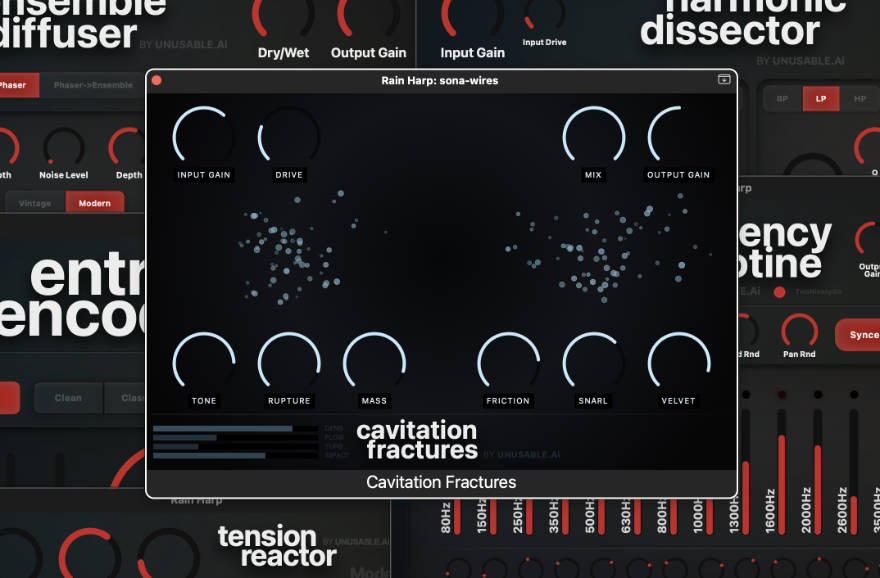
Cavitation Fractures started as another particle-DSP detour.
It ended as a distortion plugin sketch that sounds like collapsing pressure pockets and questionable decisions.
It is not released yet. The plan is a free release in April 2026 via newsletter signup.
Build loop
This project used the same Codex + local build loop:
- ideate in ChatGPT
- write a rough dev document
- hand it to a coding agent
- wire, compile, install
- test in Logic
- keep or kill
- repeat
The practical upside was speed. Time from idea to a testable AU build could be around 20 minutes, which makes weird ideas cheap to evaluate.
Particle ideas we tried and mostly buried
1) Particle Diffusion (spectral splat blur)
Particles carried spectral energy through an STFT plane, wandered with drift, then splatted into a new magnitude field.
Conceptually great. Sonically mostly fog.
2) Boids in Harmonic Space
Partials were treated as boids in log-frequency space, with neighbor rules based on harmonic ratios (2:1, 3:2, etc.) rather than plain distance.
It moved. It flocked. It was still boring.
3) Spectral Lensing
Moving mass points warped spectral envelopes in log-frequency space for formant motion without straightforward pitch-shifting.
You could hear it doing something if you listened hard enough. Not exactly a glowing endorsement.
4) Particle Reverb / Turbulence Reverb
This was the maximalist phase: geometry logic, FDN modulation, particles, portal behavior, danger zones, randomization, and too many controls.
There were occasional interesting rings, but not enough “this is actually a good reverb” moments to justify the complexity.
Pivot: Cavitation Drive
After enough failed “living space” experiments, the target changed to:
distortion shaped by bubble-collapse behavior.
This was a better home for instability.
Particles stopped pretending to be the audio and became behavior/control logic around:
- transient-sensitive event spawning
- burst and shock injection
- nonlinear fold/tanh shaping
- optional pitch-follow bias
- safety rails for destructive random states
Feedback loop and major changes
Most of the final behavior came from blunt listening feedback, not the first spec.
At one point this became the most over-engineered way to make something sound like snare wires choking against a drum head. That statement still holds up.
Key adjustments:
- tighter event triggering tied to real input amplitude
- wider simulation ranges where behavior was too polite
- safety clamping for catastrophic random combinations
- oversampling fixed at 4x, then control removed
- macro remapping passes until controls became usable
- multi-instance visual/state bleed fixes
- repeated collapse-curve tuning for low-range precision
- hot-path CPU optimization
Multi-instance CPU moved from roughly 20% per core to around 12-13% per core after optimization passes. That was the “stop here” point.
Interface and naming
The webview UI was still partly manual work in HTML/CSS/JS.
Control names were rewritten toward audible behavior rather than internal function labels:
- Collapse -> Rupture
- Body -> Mass
- Motion -> Friction
- Pitch Lock -> Snarl
- Softness -> Velvet
Friction is intentionally inverted internally: more friction means less motion.
What it sounds like
Testing note that survived all revisions:
turn down Velvet and Snarl and it can sound like R2D2 getting crushed under Jabba.
Less cinematic summary:
- percussive crack bursts
- unstable bass edge
- torn/sputtering lead textures
- “trapped inside a snare drum” moments
Release plan
This is not positioned as a universal distortion.
It is a character tool with a narrow, aggressive voice. Useful in specific contexts, not on everything.
Because of that, the plan is:
- free release in April 2026
- access via newsletter signup
Learnings
AI-assisted development remains a strong way to explore ideas that used to feel too complex or too expensive in engineering time.
In audio work especially, this matters because description quality and sonic usefulness are very different things. Fast build-and-listen loops make it easier to stop romanticizing bad ideas and keep only what actually works.